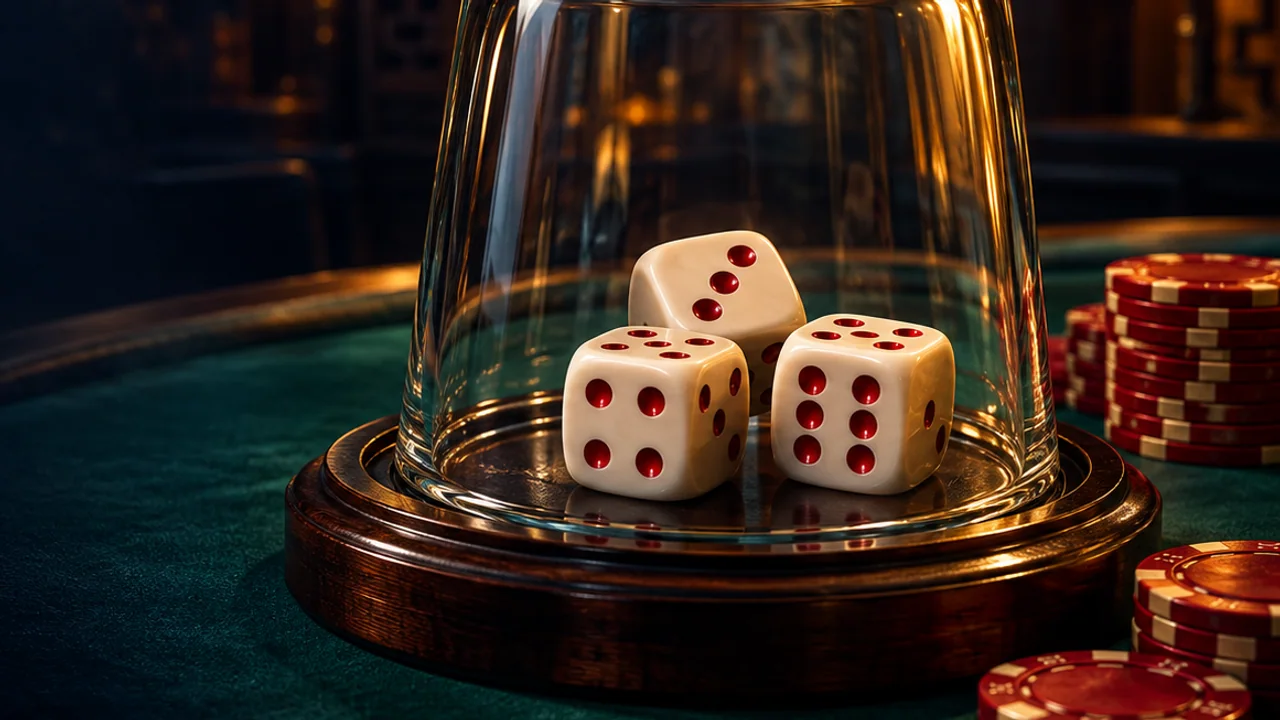
Sic bo is a dice game. The dealer shakes three dice and you bet on what they’ll show: the total, a particular number, a pair, a triple, or simply whether the total is Big or Small.
A lot of people here just call it 大小 (Big Small), after its best-known bet. Small is a total of 4 to 10 and Big is 11 to 17, and both pay even money unless the dice come up a triple.
Rounds are quick and the layout is crowded with bets. Most of them pay more than Big or Small, and most of them cost you more over time.
The dice and the layout
Three dice give totals from 3 to 18. The layout groups the bets by type: Big and Small, totals, doubles and triples, two-dice combinations and single numbers.
At a live table the dice go into a shaker, and the result comes up on screen as soon as they settle.
Payouts aren’t the same everywhere. The same bet can pay differently from one table to the next, so open the paytable before you start.
Big and Small
Small wins on a total of 4 to 10, and Big wins on 11 to 17. Both pay 1:1, and both lose on any triple, even one that adds up to a Big or Small total.
Say you put RM20 on Big and the dice show 6, 4 and 3. That’s 13, so you win RM20. If they show 5, 5 and 5, the total is 15, but it’s a triple, so Big loses.
That triple rule is the whole house edge on these bets. Without it, Big and Small would be a straight coin flip. With it, the edge is 2.78%.
Odd and Even work the same way, and at most tables they also lose on a triple.
Betting on a total
You can also bet on the exact total. Totals in the middle come up more often, so they pay less, while totals near the ends are rare and pay much more. Typical payouts:
| Total | Pays |
|---|---|
| 4 or 17 | 50:1 or 60:1 |
| 5 or 16 | 18:1 or 30:1 |
| 6 or 15 | 14:1 or 17:1 |
| 7 or 14 | 12:1 |
| 8 or 13 | 8:1 |
| 9, 10, 11 or 12 | 6:1 |
Totals of 3 and 18 aren’t on the list, because only a triple can make them (1-1-1 and 6-6-6), so the triple bets cover those.
Totals are fine as a small side bet, but they’re long shots. Even the shortest prices, 9 to 12 at 6:1, miss far more often than they land, so keep the stakes small.
Where a table pays the higher number, that’s the one to play. RM10 on a total of 4 pays RM600 at 60:1 or RM500 at 50:1, for exactly the same risk.
Doubles, triples, pairs and single numbers
| Bet | Wins when | Pays |
|---|---|---|
| Specific triple | All three dice show your number | 150:1 or 180:1 |
| Any triple | All three dice match, whatever the number | 24:1 or 30:1 |
| Specific double | At least two dice show your number | 8:1 or 10:1 |
| Two-dice combination | Both of the two numbers you picked appear | 5:1 or 6:1 |
| Single number | Your number shows on one, two or three dice | 1:1, 2:1 or 3:1 |
A specific triple is the rarest result on the table, which is why it pays the most. Any triple is easier to hit, so it pays less: RM5 on it pays RM150 at 30:1, or RM120 at 24:1.
RM10 on the combination 2 and 5 pays RM60 at 6:1 if both show up, whatever the third die says.
A single number pays more the more dice it lands on. RM10 on 6, with the dice showing 6, 6 and 2, pays RM20. Some tables pay more than 3:1 when it shows on all three.
The house edge, and the bets we’d play
Big and Small, at 2.78%, are the simplest bets on the table and the ones we’d put most of a budget on. Most of the bigger-paying bets cost more over time, and how much more depends on the paytable.
For comparison, red or black on a European roulette wheel carries 2.70%, and Banker in baccarat 1.06%.
If you like a long shot, keep the stake small and pick the table with the better payouts. Super Sic Bo from Evolution adds random multipliers to some bets each round, so read its paytable to see which bets can pick one up. You’ll find it with the other live casino games.
A few habits worth keeping
Tip: Don’t bet Big and Small together to play it safe. On a normal roll one wins and the other loses, and on a triple both lose, so the best you can do is break even.
- The dice don’t remember anything. Live tables show past results, and it’s tempting to think Small is due after a run of Big. It isn’t.
- Doubling up after losses on Big or Small (the Martingale) doesn’t change the 2.78%. A long losing run, or the table maximum, will stop you sooner or later.
- Rounds are fast, so set a budget for the session rather than thinking bet by bet.