Blackjack is you against the dealer. You want a hand closer to 21 than the dealer’s without going over. Go over 21 and you bust, which loses straight away, even if the dealer busts later in the same round.
Unlike baccarat, your decisions here change the result. Play by a simple chart called basic strategy and the house edge comes down to roughly 0.5%, depending on the table rules. Play by gut feel and it creeps back up.
Card values and the goal
Cards 2 to 10 count at face value, and J, Q and K count as 10. An ace counts as 1 or 11, whichever suits your hand.
A hand where the ace counts as 11 is called soft. A-7 is soft 18, and you can take another card without any risk of busting, because the ace can drop back to 1. A hand with no ace, or with an ace that has to count as 1, is hard.
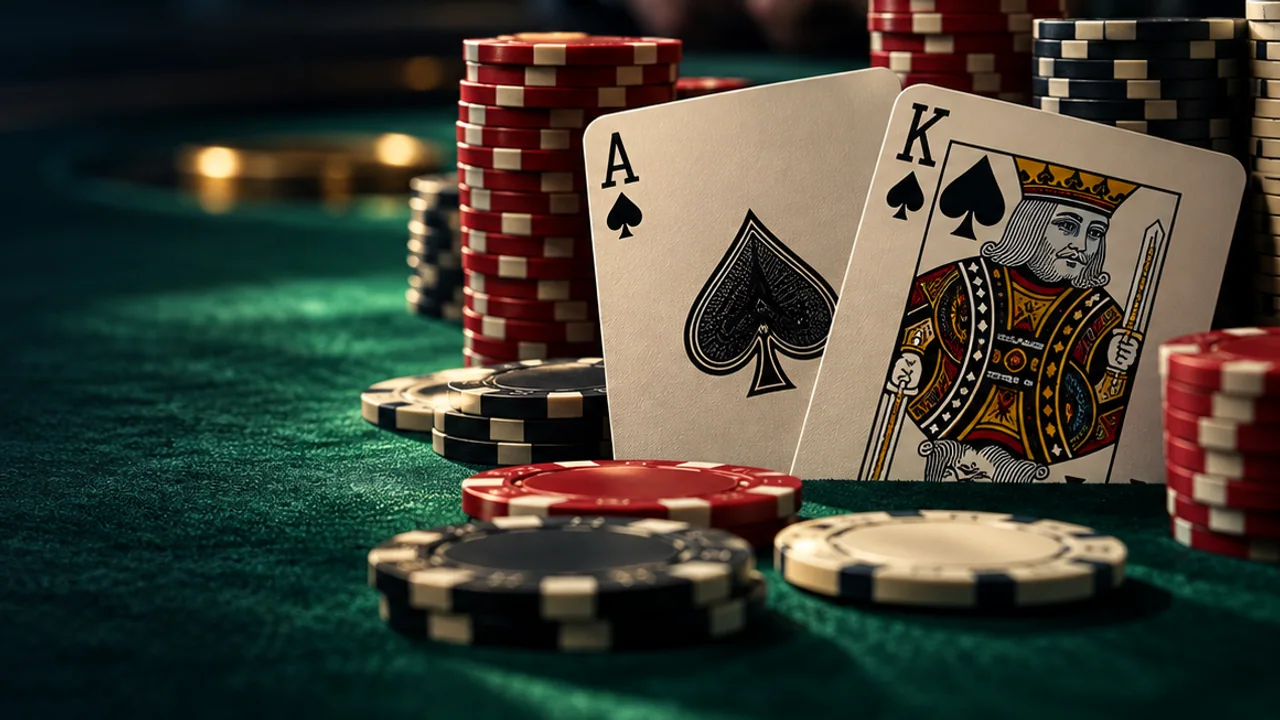
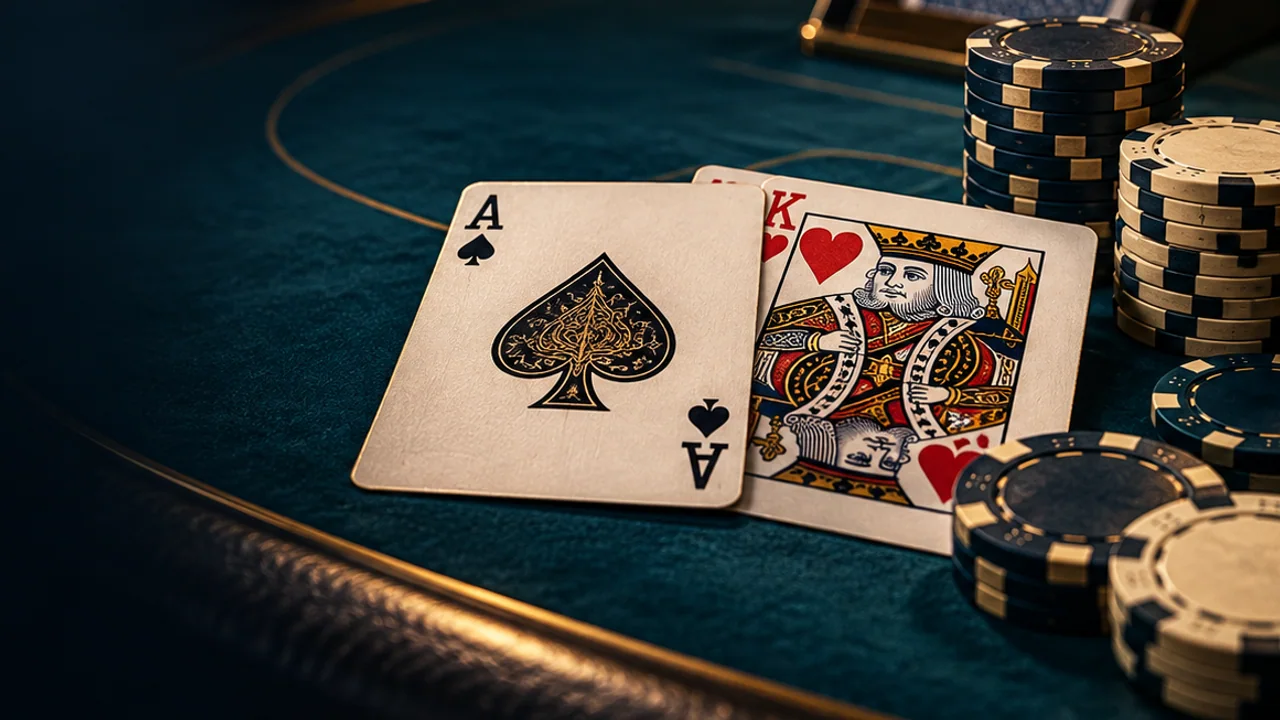
A blackjack is an ace plus a 10-value card as your first two cards. It pays 3:2, so an RM10 bet wins RM15. Any other winning hand pays 1:1.
How a round goes
- Place your bet.
- You get two cards face up, and the dealer shows one card.
- If you have blackjack, you’re paid 3:2, unless the dealer has one too, in which case it’s a push.
- You play your hand: hit, stand, double or split.
- The dealer plays by fixed rules, drawing until they reach 17 or more. Whether the dealer hits or stands on soft 17 is shown at the table.
- The higher total wins. A tie is a push, and you get your bet back.
Hit, stand, double, split or insurance
- Hit: take another card. You can keep hitting until you stand or bust.
- Stand: keep your total and end your turn.
- Double: double your bet and take exactly one more card. Use it when one card is likely to leave you with a strong hand, like 11 against a weak dealer card.
- Split: if your first two cards are a pair, split them into two hands, with a second bet the same size as the first.
- Insurance: offered when the dealer shows an ace. It’s a side bet that the dealer has blackjack, and it pays 2:1. For most players it’s a poor bet, and we’d turn it down every time.
A simplified basic strategy
This is a cut-down version of basic strategy. Full charts cover every hand and shift a little with the table rules, but this gets the big decisions right.
| Your hand | Dealer shows | What to do |
|---|---|---|
| A-A or 8-8 | Any card | Split |
| 10-10 | Any card | Stand, never split |
| 5-5 | Any card | Don’t split; play it as a 10 |
| 11 | 2–10 | Double |
| 10 | 2–9 | Double |
| Hard 12 | 4–6 | Stand |
| Hard 12 | 2, 3 or 7+ | Hit |
| Hard 13–16 | 2–6 | Stand |
| Hard 13–16 | 7+ | Hit |
| Hard 17+ | Any card | Stand |
| Soft 18 (A-7) | 2, 7 or 8 | Stand |
| Soft 18 (A-7) | 3–6 | Double if allowed, otherwise stand |
| Soft 18 (A-7) | 9, 10 or A | Hit |
With 11 or less, if you’re not doubling, always hit, since you can’t bust.
It feels wrong to hit a hard 15 against a dealer 10, but that’s what the maths says. Over many hands, standing there costs you more.
Tip: Keep the strategy chart open on your phone or in another tab while you play. Nobody at a live table can see it, and after a few sessions you’ll hardly need it.
Live blackjack variants
Live tables follow the same rules, often with 8 decks, and each table shows its own rules on screen. Two live versions worth knowing come from Evolution.
Infinite Blackjack has no seat limit, because everyone plays from the same starting cards and makes their own decisions. Lightning Blackjack adds random multipliers, and its rules panel explains how they’re won and what they cost.
Read the rules panel at any new table before your first hand. Whether the dealer stands on soft 17 and when you’re allowed to double both change the right play. Our live casino guide covers how the live tables work in general.
Mistakes to avoid
- Taking insurance. It feels like protection, but for most players it costs more than it saves.
- Standing on hard 13 to 16 against a 7 or higher. Fear of busting makes people freeze. The chart says hit.
- Not doubling 11. It’s one of the best spots in the game to get more money on the table.
- Splitting 10s. You’re breaking up a 20. Leave it alone.
- Copying the dealer. Hitting until 17 whatever the dealer shows ignores the most useful information you have.
- Chasing losses. Doubling your bet after every loss (the Martingale) doesn’t change the edge, and a losing streak or the table limit ends it sooner or later.
If you like a game where your choices count, poker is the other one worth learning. The rest of what we cover is on our games page.